Road Base Hamilton
Properly compacted pavement layers that give roads a lasting foundation.
07 8087 881Road Base & Sub-base Preparation in Hamilton
A road is only as strong as the base beneath it, making proper sub-base preparation one of the most critical stages of any roading project. Our road base and sub-base preparation services in Hamilton ensure correct material selection, compaction and layering to meet engineering specifications for subdivision and civil roading works.
We carefully assess soil conditions and drainage requirements before construction, minimizing the risk of settlement, cracking or premature pavement failure. Getting this stage right prevents costly rework further down the line and ensures roads pass council inspection without issues. Our experienced team brings the equipment and technical know-how needed to deliver a solid, compliant foundation for lasting roading infrastructure.
Free estimate
Road Base and Sub-Base Preparation Services in Hamilton
Road pavements in the Waikato are commonly built as layers of compacted aggregate over a prepared subgrade, then sealed or surfaced. We handle each of those layers with the right materials and machinery, working to the pavement design and your engineer's testing regime so the structure spreads traffic loads evenly into the ground below.
Subgrade Assessment And Proof Rolling
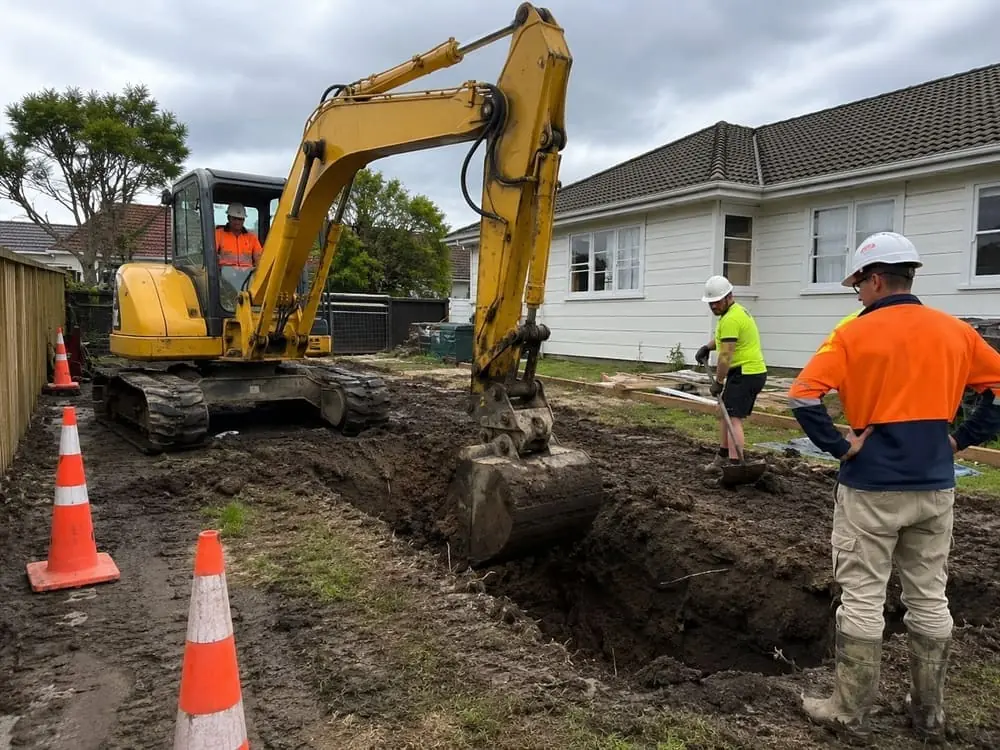
Before any aggregate goes down, the exposed subgrade is checked for soft or wet areas. We proof roll with loaded machinery or assist your engineer with testing so weak spots show up early, when they are cheap to fix, rather than months later as potholes or deformation in the finished road.
Undercut And Subgrade Improvement
Where testing finds poor ground, we dig out the unsuitable material and replace it with compacted hardfill, or install geotextile or geogrid where the design calls for it. On some sites the engineer may specify lime or cement stabilisation, which we can coordinate with specialist providers.
Sub-base Placement
The sub-base layer spreads loads and protects the subgrade. We place the specified aggregate in lifts of the right thickness, moisture condition it as needed and compact with appropriately sized rollers, checking levels as we go so the layer is uniform across the full width of the road.
Basecourse Construction
Basecourse is the high-quality aggregate layer directly under the surfacing. We place and compact it to tight level tolerances and shape it to the design crossfall, producing a dense, tight surface that sheds water and gives chip seal or asphalt a sound, even layer to bond to.
Moisture And Compaction Control
Aggregates compact best within a narrow moisture range. We water or dry out material as needed, choose the right roller for each layer and make enough passes to meet the specified density. Doing this carefully is one of the biggest factors in how long a pavement lasts.
Pavement Drainage
Water trapped in pavement layers weakens them quickly. We install subsoil drains, shape layers to shed water towards the edges and coordinate with kerb, channel and sump installation, so rainfall and groundwater are carried away from the pavement rather than soaking into the subgrade underneath.
Level And Crossfall Checks
Using laser and GPS-guided equipment, we trim each layer to the design levels and crossfall. Consistent levels mean surfacing thicknesses stay even, water drains to the channel and the road rides smoothly. We keep level records that support your as-built plans and engineering sign-off.
Private Roads And Yard Pavements
The same pavement principles apply beyond public roads. We build compacted base layers for private roads, rights of way, carparks, commercial yards and hardstands, sized for the vehicles that will use them, from domestic cars to heavy trucks, forklifts and farm machinery.
Benefits of One Contractor for Road Base and Pavement Layers
The strength of a pavement depends on the stages either side of it: a well-prepared subgrade below, and kerbs, services and surfacing built on top. Because we also form subdivision roads, access ways, drainage and kerb and channel, sub-base and basecourse are placed with the next layer already planned. Service crossings are laid and compacted before the aggregate goes down, levels and crossfalls are checked by the crew that will build the kerb line, and there is no idle gap for the subgrade to soften in Waikato weather.
Hamilton Road Base and Sub-base Contractors: Our Scope
Pavement work starts with the exposed subgrade, so soft or wet areas are found and dealt with before any aggregate goes down.
Included in the scope
- Subgrade proof rolled to show up weak spots early
- Sub-base aggregate placed in lifts and rolled to density
- Basecourse trimmed to tight tolerances and design crossfall
- Aggregate moisture conditioned so each layer compacts properly
- Layer levels recorded to support as-builts and sign-off
Confirmed separately
- Undercut and hardfill replacement where testing finds poor ground
- Lime or cement stabilisation through specialist providers
- Geotextile or geogrid where the pavement design calls for it
- Density and bearing tests arranged by your engineer
- Final chip seal or asphalt by surfacing contractors