Kerb & Channel Hamilton
Accurately aligned concrete kerb and channel that carries stormwater where intended.
07 8087 881Kerb & Channel Installation in Hamilton
Kerb and channel installation plays a critical role in directing stormwater safely away from roads and building sites within any subdivision. Our kerb and channel services in Hamilton are built to council specifications, ensuring proper alignment, drainage function and long-term durability. We handle everything from formwork and concrete placement to finishing, ensuring a clean, compliant result that integrates seamlessly with the wider roading and drainage network.
Correctly installed kerb and channel systems prevent water pooling, erosion and pavement damage over time, protecting the overall investment in subdivision infrastructure. Our experienced team works efficiently across staged developments, helping keep your project on schedule and compliant with engineering requirements.
Free estimate
Kerb and Channel Services in Hamilton
Kerb and channel is a small part of a subdivision by area, but it strongly affects how the road drains and how the finished street looks. We set out from the engineer's design levels, prepare a firm base, and form or place concrete to the profile specified, finishing crossings, sumps and transitions so everything ties together neatly.
Set-Out And Level Control
Accurate levels are what make a channel drain. We work from survey set-out and design levels, checking grades along the full length so water runs consistently towards sumps. Getting the line and fall right before concrete is placed avoids flat spots, standing water and costly cut-outs after inspection.
Subgrade And Bedding Preparation
The kerb needs a firm, even base to stay straight over time. We trim and compact the subgrade along the road edge, place and compact bedding material to the required depth and remove soft spots, reducing the risk of cracking, settlement or the kerb rotating away from the pavement.
Formed Or Extruded Kerbing
Depending on the profile and project, kerb and channel can be hand formed with boxing or slip-formed by machine. We match the method to the job, keeping profiles consistent with the approved standard drawing and producing tidy, uniform lines along straight runs, curves and cul-de-sac heads.
Vehicle Crossings And Drop Kerbs
Each lot typically needs a vehicle crossing, and pedestrian routes need lowered kerbs at crossing points. We form these transitions to the council profile, allowing for driveway gradients and accessibility requirements, so future owners can build their driveways without breaking out and replacing sections of new kerb.
Sumps And Catchpit Tie-ins
Channels only work when they deliver water cleanly into the stormwater network. We coordinate kerb levels with sump and catchpit positions, form the inlet transitions correctly and make sure grates and lintels sit at the right height, so water enters the system instead of bypassing it.
Concrete Finishing And Curing
We finish kerbs with clean arrises and a consistent surface texture, then cut or tool control joints at the required spacing to manage shrinkage cracking. Fresh concrete is protected from rain, traffic and hot drying winds while it cures, helping the kerb reach its intended strength and appearance.
Backfill And Road Edge Tie-in
Once the kerb has cured, we backfill behind it and compact the berm area to support the edge. On the road side, we coordinate with the basecourse and surfacing so the seal or asphalt meets the channel lip neatly, without a step that could trap water or damage vehicle tyres.
Repairs And Replacement Sections
Damaged or sunken kerb from earlier construction traffic can hold up sign-off. We cut out and replace failed sections, match the existing profile and colour as closely as practical and reset levels where needed, so defects identified at inspection are cleared quickly and do not delay your completion.
Why Kerb and Channel Works Best Alongside Your Roading Contractor
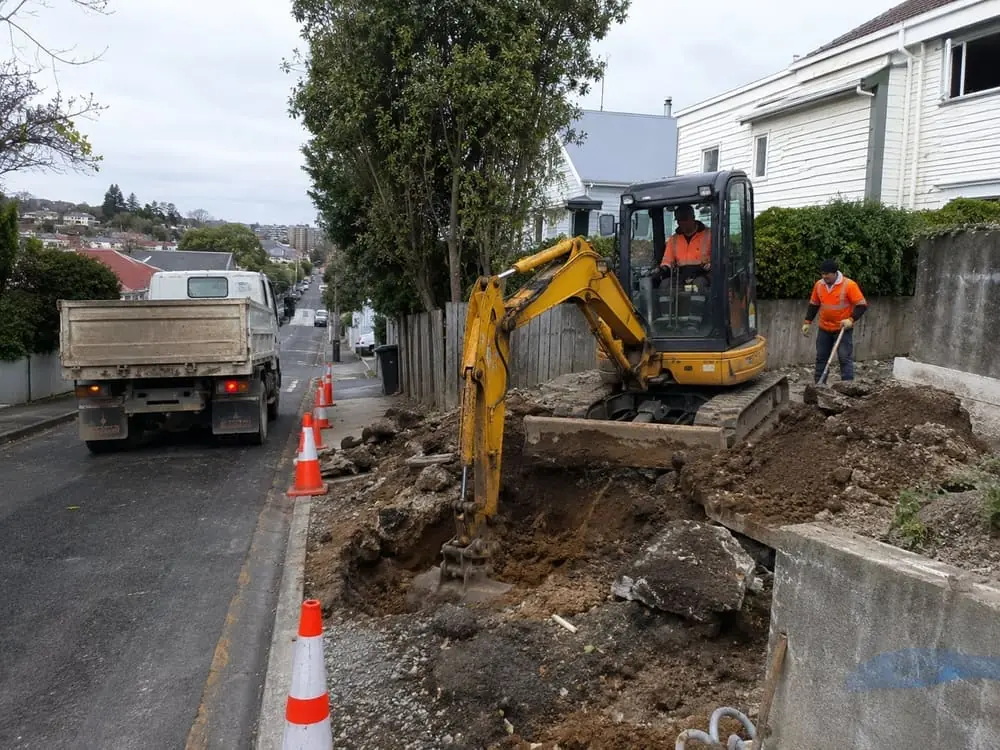
Kerb and channel is set to the same levels as the road pavement, footpath and stormwater sumps around it, so it pays to have one contractor building all of them. When our crew prepares the subgrade and basecourse, then forms the kerb line and ties in the footpath and vehicle crossings, levels carry through without mismatches between trades. Any adjustment is resolved on site by one team, and you have a single contact working through inspections with the engineer.
Hamilton Kerb and Channel Contractors: Our Scope
Kerb work starts with survey set-out and design levels, so the channel falls consistently towards each sump before concrete is placed.
Included in the scope
- Line and grade checked along the full run
- Subgrade trimmed and bedding compacted along the road edge
- Kerb hand formed or slip-formed to the approved profile
- Control joints cut and fresh concrete protected while curing
- Berm backfilled and compacted behind the finished kerb
Confirmed separately
- Vehicle and pram crossings priced by number and location
- Soft spots in the subgrade needing extra dig-out
- Kerbing delivered across several stages rather than one run
- Cut-out and replacement of damaged sections before sign-off
- Survey set-out supplied by your surveyor or engineer